Donna is ready to use ru en
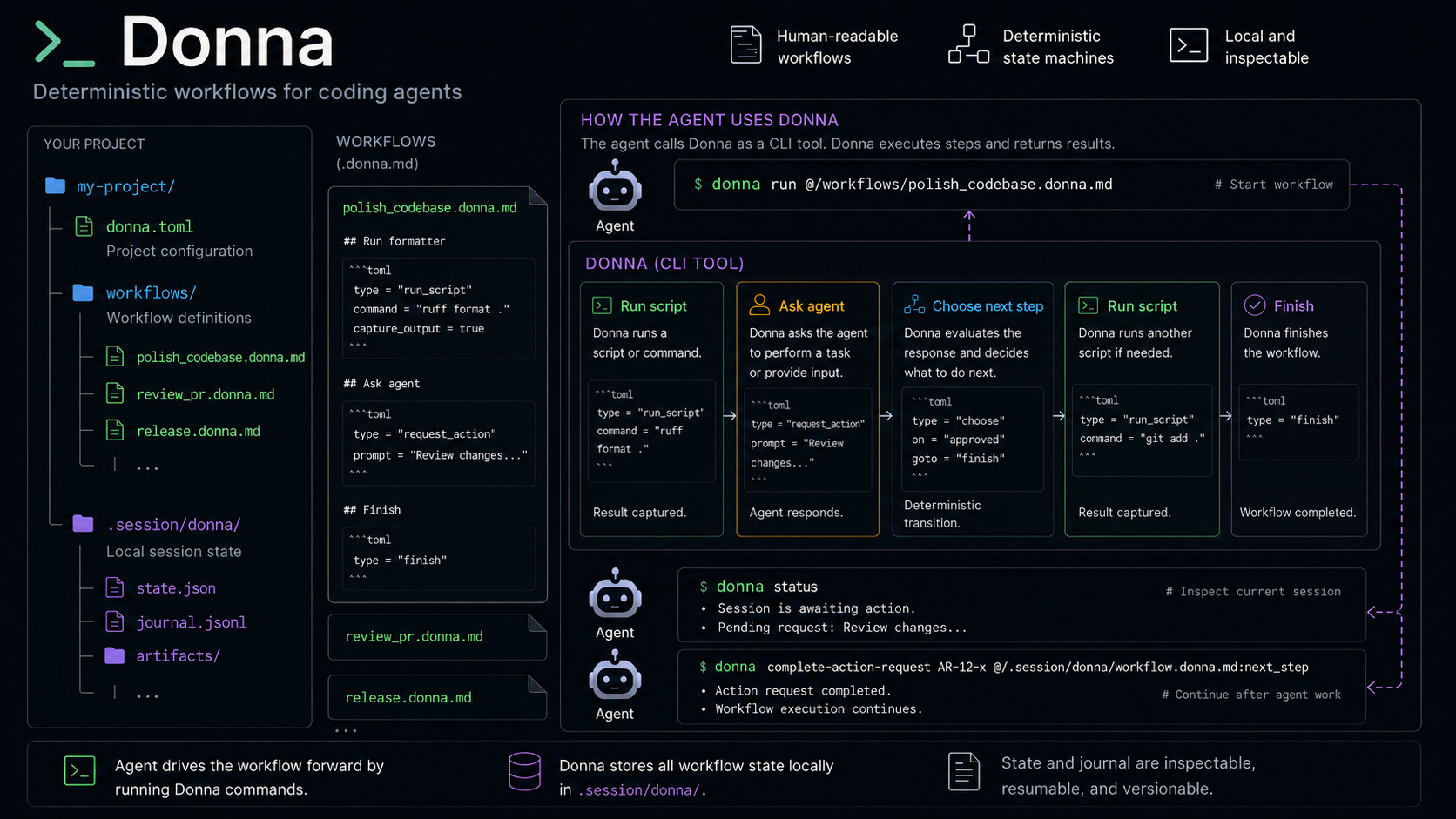
How Donna works.
In February, I released Donna (the original post) — a CLI tool to run agent workflows as state machines and describe them in Markdown files.
Since I was developing it simultaneously with learning how to work with agents, Donna came out as an overcomplicated, versatile monster. It had many features, all of which were useful, but in total, they restricted the developers' environment too much and required too much time to learn.
So, after I gained some experience, I decided to follow the Unix philosophy and refactor a single monolithic tool into a set of smaller tools with single responsibility. New Donna is the first one of them (and the second is depmesh — I'll tell about it in a separate post).
New Donna exists to solve the control flow problems of agents in the long run. The logic is as follows:
- Most development work is repetitive on the meta level: "run this tool, do something with the output, run another tool" or "implement function A, implement tests for function A, implement function B, …".
- Some parts of that work require advanced reasoning, others do not.
- Agents are
almostgood at reasoning, but not so good at keeping the whole process in mind, remembering what they did, what they should do and in which order, etc. - Therefore, we should separate the reasoning part from the control flow part — let agents focus on what they are good at, and keep the control flow to traditional automation tools.
Donna runs predefined workflows as deterministic state machines, so the agent can focus on reasoning, code generation, and other agentic work.
How Donna works
You define a workflow in a single readable Markdown file. The agent asks Donna to guide it through the workflow; Donna maintains the execution state, selects the next operation, and tells the agent what to do or report next.
Workflows can start child workflows, be generated on the fly, or be modified while executing. For example, you can have a workflow that guides the agent through the planning process, and at the final step, the agent can generate a new workflow with a detailed plan to execute and run it immediately.
As a bonus, Donna saves tokens because the agent does not need to reason about control flow or how to execute particular CLI commands and other automation tools.
Example
Here is a toy example of a workflow that checks the current time, asks the agent whether it is time to drink tea, and branches according to the agent's answer.
The abstract schema of the workflow looks like this:
[Get Current Time]
          |
          v
   [Ask About Tea]
          |
     +----+----+
     |         |
    yes        no
     |         |
     v         |
  [Turn On     |
   Kettle]     |
     |         |
     +----+----+
          |
          v
       [Finish]
And here is the source of this workflow in Donna's Markdown format:
# Is it time to drink tea?

This workflow checks the current time, asks the agent whether it is tea time,
and branches on the answer.

## Get Current Time

```toml donna
id = "get_current_time"
kind = "donna.lib.run_script"
save_stdout_to = "current_time"
goto_on_success = "ask_about_tea"
goto_on_failure = "finish"
```bash donna script #!/usr/bin/env bash date +%H:%M
## Ask About Tea

```toml donna
id = "ask_about_tea"
kind = "donna.lib.request_action"
The current time is:
{{ donna.lib.task_variable("current_time") }}
Is it time to drink tea?
- If yes,
{{ donna.lib.goto("turn_on_kettle") }}. - If no,
{{ donna.lib.goto("finish") }}.
Turn On Kettle
```toml donna id = "turn_on_kettle" kind = "donna.lib.request_action"
Turn on the kettle, then `{{ donna.lib.goto("finish") }}`.

## Finish

```toml donna
id = "finish"
kind = "donna.lib.finish"
The workflow is complete. You are a good butler. ```
This workflow is taken from Donna's README.md, you can find the detailed explanation of how it works there.
Real usage cases
My primary use case for Donna is creating code polishing workflows for my projects, like that one: polish.donna.md.
Such a workflow performs formatting, runs tests, linters, spellcheckers, and other quality-related tools, and if any issues are found, it asks the agent to fix them. It does that in a loop, until all the issues are fixed, by executing operations in the fixed order after each change.
My agent is instructed to run the Polish workflow at the end of the current work scope and at the end of each significant part of work, when the project is expected to be in a consistent state.
Such a workflow saves me a lot of manual work and code-review time, especially after I introduced tach to my projects to lint/restrict code dependencies.
The second use case is asking an agent to generate workflows for themselves when they need to do something complex. For example, when I want to ensure that a complex refactoring is done in the correct sequence, or that every file is processed in the same way.
My wife resently started using Donna for translating some chines novels for personal use. I helped her generate nearly 5 workflows; she iteratively tuned them to achieve expected behavior and quality, and now they are translating something in the background. No coding was required.
Looking for early adopters
I use Donna every day and think it could bring a lot of value to others. So, if you are interested, try it out, and let me know what you think. I'm always ready to help you with it, and your feedback is very important to me.
Don't worry about support or long-term maintenance — I use Donna in all my projects every day, so I will maintain it in any case. And I'm fast at introducing new features and fixing bugs on demand.
Read next
- Donna — predictability and controllability for your agents
- DepMesh — making file dependencies part of project architecture
- Notes on coding agents
- My GPTs and prompt engineering
- LLM agents are still unfit for real-world tasks
- Prompt engineering: building prompts from business cases
- Migrating from GPT-3.5-turbo to GPT-4o-mini
- Top LLM frameworks may not be as reliable as you think
- Dungeon generation — from simple to complex
- World Builders 2023: Preferences of strategy players