Rust: the language things get rewritten in en ru
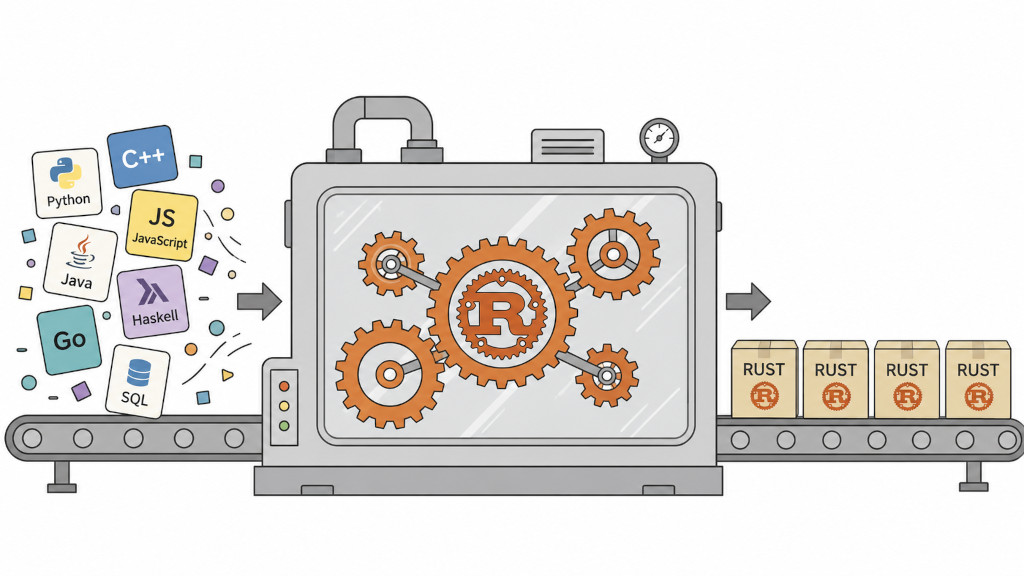
Rust is slowly but inexorably refactoring humanity's codebase.
About 5 years ago, I was going through Rust documentation and decided that I didn't like Rust [ru].
Last year, I needed to prototype some game logic and chose Rust for that task, as I couldn't find anything better: Zig looked too immature, and C++ is getting more and more dead complicated with every standard.
As a result, I wrote 10 pages of notes on my experience, which unexpectedly boiled down to a compact statement in the title. And if you are too lazy to read further, then this is praise, not criticism.
However, I still stick to my opinion from the previous post:
A good tool shouldn't constrain its user, because the tool's developer can never anticipate every possible use case.
According to my understanding of beauty of how technology works, a programming language built on Rust's principles should have a near-zero chance of success. However, the de facto situation is exactly the opposite: Rust is rapidly gaining popularity, and after working with it, I have to admit it's a good and powerful tool. But good grief, it's just wrong. Who does things this way?
From my point of view, Rust's success is caused by two factors:
- The tremendous professionalism and experience of its creators and core team.
- The maturity of the software development industry.
I'll try to concisely describe the primary conceptual difference between Rust and other languages; why that difference is both its strength and its weakness; and why, for several years now, there has been an ongoing trend of rewriting everything in Rust.
This post is based on strictly subjective experience
I used Rust for only a year; for prototyping and experimentation; in game development.
Consequently, I'm not in a position to claim expertise in Rust or an unbiased view of it.
For example, some of the difficulties I experienced may have been due to the fact that I was simultaneously prototyping and learning the language. That is, they may have been a consequence of my choice, rather than properties of the language.
At the same time, I have enough development experience to extrapolate from that year to more general cases and form my own subjective opinion on the matter. That is what I will do in this essay.
The cost of composition
Composition wins over inheritance [ru] in most general cases due to better flexibility, more variability, less coupling, and, consequently, better maintainability of the result.
That's why most programming languages are organized around orthogonal rules/mechanisms/components that developers can combine and use at their discretion.
You don't pay for what you don't use
Since ancient times, the default convention has been that language features should compose according to the principle: "you only pay for what you use". For example, in C++, this is even one of the key design principles: What you don't use, you don't pay for. This is often interpreted as a performance requirement, but in my view, it also applies to the mental load on the programmer.
For example:
- In C++, if you don't use exceptions, you have no need to think about how they work, you don't need to use their syntax in your code, you don't need to provide special optimizations for them, and so on.
- In Python, if you don't want to use classes, you simply don't use classes.
Some languages partially deviate from this principle. For example, historically (until the requirement was relaxed in 2025), Java required you to use classes even if you didn't need their capabilities, but this is more a case of pushing one feature to the extreme than a rejection of the principle itself.
As a consequence of this approach, language features do not restrict the use of each other. For example, in C++, you can use classes, exceptions, templates, lambdas, and so on in any combination you need.
By composing language features without restrictions, a programmer can create very efficient, powerful, and flexible systems — if they are a professional. Or create buggy systems with a million security holes if they lack professionalism.
Moreover, and this is important, without restrictions on feature composition, it becomes much easier to experiment — trying different architectural solutions, patterns, programming styles, etc.
You'll pay for everything
Rust chose a different path.
Its mechanisms are still orthogonal to each other, but only in terms of responsibility for something, not in the ability to turn their use on/off or compose them in any way. Instead, they require you to use them in conjunction with other language features in very particular cases. Instead of Lego bricks, you get a welded rigid grid in which you must somehow fit your architecture and code. Nodes of such a grid become global invariants that you must follow and cannot break, move or bypass.
For example, you cannot "just not use lifetimes" (substitute borrow checker, traits, etc.) — you must either use it or build your architecture in a highly specific way around it (if that is even possible).
This sharply reduces variability — limits the ability to experiment, but, at the same time, limits the ability to make mistakes.
The presence of global invariants imposes certain architectural decisions, which in many cases can be considered best practices. Rust forces you to implement a more good, right, reliable architecture whether you need it or not.
To be productive, a Rust programmer has to keep all of the language's mechanisms in mind at once: standard traits, lifetime rules, borrow-checker rules, and so on. Moreover, they have to keep them in mind, not in isolation, but together with all possible interactions and constraints on composition.
Learning Rust as a professional or a beginner
The need to keep the entire language, with all its nuances, in your head creates a high barrier to entry.
In my opinion, that explains a popular view: "it is easier for a beginner to get into the language than for a professional to switch to it".
A beginner learns from the start to think within constraints. A professional already has experience composing code without those constraints, and starts bumping into Rust's restrictions invariants on every line of code.
The convenience and usefulness of a language built on such principles will be determined primarily by the quality of chosen abstractions and the quality of standard-library implementation. "One wrong move, and you're done" — people won't be able to use your language for real-world tasks.
Somehow, Rust managed to do it.
I don't fully understand how. In my opinion, besides the exceptional competence of its creators, this phenomenon is clear evidence of the maturity of the software development industry — most software has become highly formulaic, and Rust's designers managed to create a set of invariants that allow those patterns to be implemented reliably.
Why everything is being rewritten in Rust
My hypothesis is that humanity has completed the phase of experimentation with "foundational" software infrastructure and is moving into the phase of stabilizing it.
We think that We "know" the principles on which sudo, coreutils, web servers, databases, user interfaces, and so on should operate.
The less we need to experiment with architecture and programming style, the less the pressure toward choosing languages with unrestricted feature composition.
The more we need reliability, security, and predictability, the greater the pressure toward languages with restricted feature composition.
Rust, in turn, provides not only reliability but also convenient semantics for describing standard/correct/secure architectures.
This leads directly to two "movements":
- Bottom-up — the classic "I can do it better", I'll invent my own wheel, with blackjack, and improved reliability approaches push enthusiasts to choose Rust for
rewritingcreating alternatives to existing software, because Rust doesn't get in the way of "doing it right" and protects you from attempts to "do it wrong". - Top-down — corporations start moving their infrastructure to Rust because the value of experimenting with code is decreasing, while the costs of bugs and vulnerabilities are increasing. Why experiment if everything is already standardized and it is roughly clear how it should work according to best practices?
Rust itself is moving in roughly the same direction. For example, here is a quote from one of Rust's core developers, from his post Rust in 2025: Targeting foundational software:
I see Rust's mission as making it dramatically more accessible to author and maintain foundational software. By foundational I mean the software that underlies everything else.
"Foundational software" is a broad and vague term; however, in essence, it is software at the levels below what an ordinary user sees, software that provides the basic expected/standard capabilities for everything we build on top of it.
Advantages of Rust
First, Rust pushes you to create reliable standard software by following a subset of best practices.
In theory, this applies to most commercial software and a substantial share of open-source software.
For example, I'm considering switching my web specialization from Python to Rust, because it is hard to imagine anything more formulaic than modern web development.
Second, because Rust constrains architecture variability, it should be well suited to development with coding agents — the space for error becomes much smaller (assuming you ban unsafe).
Third, as a consequence of being forced to follow best practices, Rust's standard library and the core of its ecosystem are quite good.
We can leave this section there. It turns out that Rust is something of a workhorse for routine engineering work.
Better yet, let's talk about Rust's drawbacks.
Rust's downsides
Rust's problems come from the same place as its advantages — the lattice of rigid invariants.
High barrier to entry
You cannot choose a subset of the language and start building a moderately complex project with it — you need to keep the whole language in your head.
Otherwise, you will keep methodically running into a wall, learning something new, and reworking your code, only to run into another wall.
This is hard for experienced programmers because many of them (including me) are used to learning by trial and error — especially when no human lives, financial losses, or other terrible things are at stake.
By the way, Rust was the last language, in my observations, that LLMs had trouble with.
High cost of prototyping and experimentation
The classic approach to prototyping assumes that once the hypothesis has been tested, we throw away the whole prototype or a part of it.
The speed of getting a visible result is orders of magnitude more important than quality, reliability, or anything else. That is why, when prototyping, we always cut as many corners as possible, using our knowledge of how the prototype will be used and our understanding of the whole system being prototyped.
For example, if I am writing a library that will be used only by me and only in a single-threaded mode, I do not want to think at all about synchronization, violations of multithreading invariants, and so on. I do not want to know how Rust handles multithreading, I do not want to learn how it does it, and I do not want to add anything to my code to account for it — this code will be thrown away in a month. I just want to write code that works in a few particular cases, and test the hypothesis. Regardless of whether the third-party libraries or standard-library containers I use are designed for multithreaded scenarios.
Or say I do not want to think about who or what owns the data, because I am absolutely sure that in this particular part of the system, it is completely irrelevant — and even if it is not, it will not affect the usefulness of the prototype.
In Rust, it is hard to cut corners even using unsafe. For example, unsafe does not remove restrictions on data lifetimes.
In my view, this is exactly why game development in Rust still has not become widespread. Gamedev is one of the few remaining fields where prototyping and experimentation are still important — and may well remain important for the foreseeable future.
That's why I recommend prototyping in a language other than Rust and rewriting the result in Rust once it is clear how the result should work. For example, here is a developer prototyped a filesystem in Python and later rewrote it in Rust.
It is hard to vary code quality
The logic is pretty much the same as with prototyping, but the point here is that different parts of a single project may have different quality requirements.
For example, simplifying a bit, your decision on data lifetime will shape all the places where you use that data.
Some degree of variation is possible, for example, in how paranoid you are about handling errors, but overall, it is harder to write garbage code in one part of the system and keep beautiful architecture in another.
Rust pushes you to overengineer
Because Rust gets in the way of writing simple bad code and, at the same time, provides tools for writing complicated good code, it ends up shifting the balance toward more complicated code.
And, as we all know, there is no limit to perfection. It is very convenient and fun to play with traits and build abstraction levels — it feels like solving programming-contest problems.
Here is a quote from a developer with 4 years of experience with Rust, from the post Everybody's so Creative!:
I love the language – but I'm starting to think the ecosystem has an abstraction addiction. Or: why every Rust crate feels like a research paper on abstraction.
I have exactly the same impression.
Potential future problems
C++ got stuck due to the requirement for full backward compatibility and the committee's rigidity.
Rust may become a victim of its own rigidity, because that rigidity constrains not only our code, but also the design of the language itself. The more tightly coupled its mechanisms are, the harder it becomes to change the language and add new mechanisms, because they must be consistent with the existing ones and must not break them.
Adding a mechanism that is tightly coupled to all the others will automatically lead to quadratic growth in the language's cognitive complexity.
That already leads to huge delays in adding new mechanisms:
- Adding generic associated types took more than 6 years.
- The generic specialization issue has already been open for 10 years.
Moreover, the current trait rules already partially constrain the potential development of the library ecosystem. Because of how traits work, the ecosystem becomes tightly tied to a set of key third-party libraries — for example, serde — a serialization framework. If someone creates a more convenient framework in the future, migrating to it will be complicated because someone will need to add support for it in all the libraries of the ecosystem (as is currently done for serde). Of course, there is more than one such library, and it turns out that Rust's rigidity leads to the same rigidity in the ecosystem. If nothing changes, this rigidity may lead to the stagnation of the language in the future.
Here is an excellent post about the problem and how people are trying to solve it: An incoherent Rust.
Rust's impact on software reliability may be overstated
In the post in defense of C++ Dayvi Schuster makes a strong argument:
…any rewrite of an existing codebase is going to yield better results than the original codebase.
In other words, the reliability and security of software written in Rust may be a consequence not only of Rust's semantics, but also of the fact that:
- We have generally started writing better software and choosing better architectures.
- In the case of rewriting software in Rust, all the major mistakes have already been made by the developers of the original software, and the architecture has already stood the test of time. As a result, the developers doing the rewrite start with a task that is inherently less complex and less risky.
Rust sets a high bar for programmers
A team of Rust developers will be skilled and expensive — an option that is not suitable for every company or every project. Architectural mistakes in Rust software may occur less often, but they can cost significantly more because they will be at a more "fundamental" level.
AI could, in theory, lower skill requirements, but for now, it is more of a theory. My personal experience with coding agents suggests that agents handle code very well, but handle architecture and long-term planning very poorly. Most of the issues in a Rust project will come precisely from architectural mistakes.
My personal impressions of Rust and plans for it
- As someone prone to perfectionism, I like Rust because it forces you to write correct code.
- As a former competitive programmer, I like Rust because it gives me fun problems to solve. They feel roughly like C++ template problems — the experience is about the same. The difference is that in C++, you solve such problems only when working with templates; in Rust, you solve them all the time.
- Ideologically, I dislike Rust because it limits the programmer's freedom.
- In the short and medium term, Rust will most likely keep eating into the market for standard/foundational/formulaic software, whatever those terms mean in this context.
- In the long term, I see a risk that Rust may dig itself into the same hole C++ has been digging itself into for the last 20 years.
So for now, I'm inclined to switch to Rust if the opportunity or need arises. At the same time, I'll be ready to jump ship at any moment and move to something more flexible.
Useful links
If you want to dig a little deeper, here are a few interesting links:
- A collection of real-world cases where companies decided to adopt Rust or reject it.
- Examples of real-world Rust problems.
- A visualization of borrow-checker complexity.
- An excellent explanation of how traits work, with pictures.
Read next
- Two years of writing RFCs — statistics
- Dungeon generation — from simple to complex
- World Builders 2023: Preparing a business plan for a game on Steam
- Generation of non-linear quests
- Notes on coding agents
- Thinking through writing
- Prompt engineering: building prompts from business cases
- World Builders 2023: Preferences of strategy players
- Vantage on management: No instructions for engineering
- Vantage on management: Hypothesis testing loop