Results of the 2024–2026 sabbatical ru en
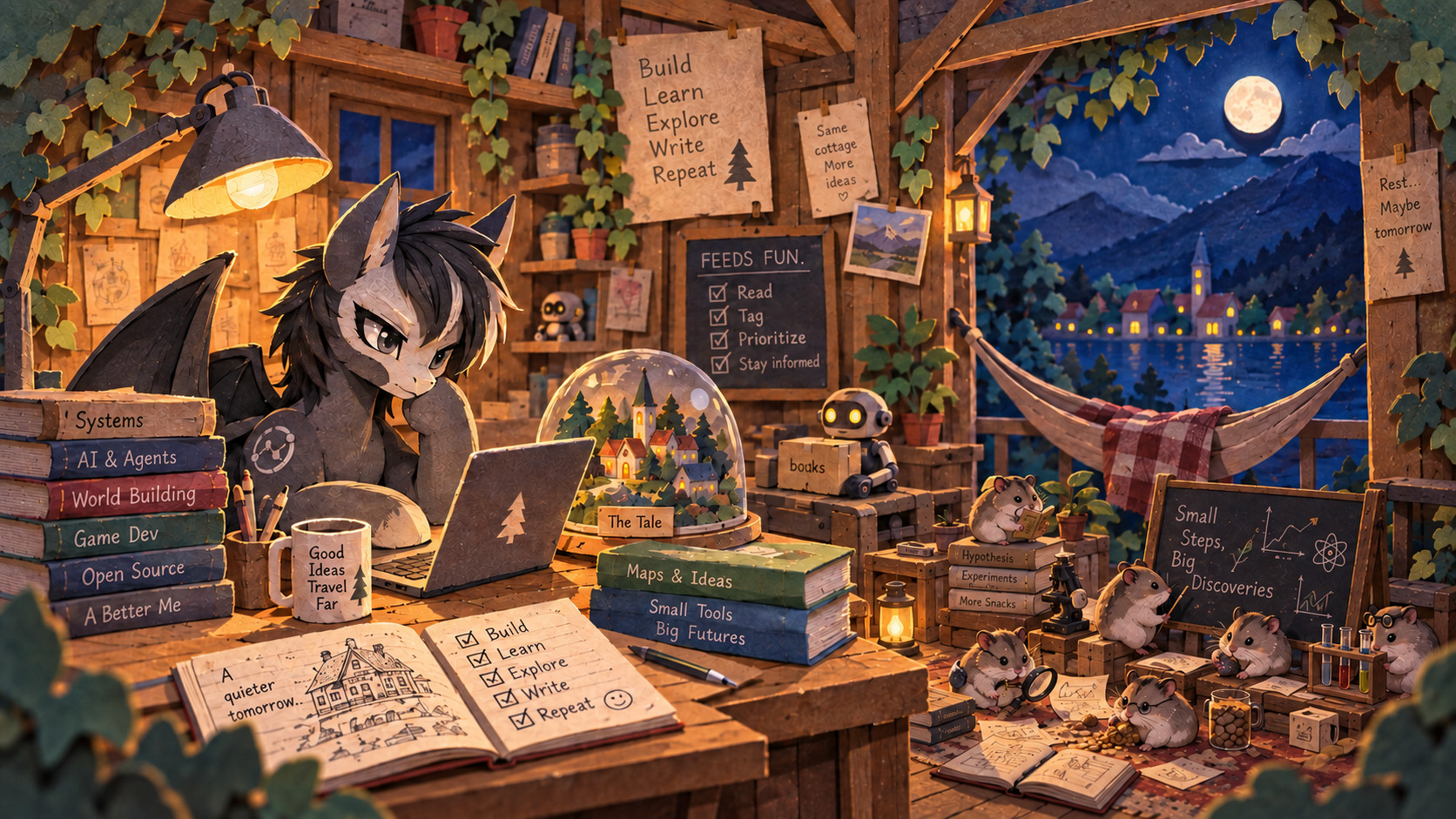
Idiomatically spending a sabbatical.
In 2023, Yuliya made a table of 1000 labs (!), chose one, moved to Germany, and started doing a PhD there. For a year, we flew back and forth between Poland and Germany, realized it was terribly inconvenient and expensive, so I quit Palta and, at the beginning of 2024, moved to Germany as a trailing spouse.
"What a great excuse to take another sabbatical", I thought, and so I did. Two and a half years later, it's time to look for a job take stock.
In this post, you'll find a full report on all the resting I managed to get done: what was planned, how the plans changed, what was achieved, and what was not.
In short: blog updated, 68 posts written, 20 books read, 4 new open-source projects built, more than 400 GitHub stars earned, feeds.fun made genuinely usable and ready for monetization, my own approach to management formulated, some weird but interesting courses on intellectual property development completed, AI figured out, coding agents coding, my wife's eye twitching.
A few links to better understand the post:
- What are sabbaticals and why I take them.
- This is my second full sabbatical; here is the report on the first one.
Plan
The sabbatical was planned in advance and covered the following areas.
Primary goals:
[done]Finish moving the family to Germany, solve household issues.[done]Brush up on management theory.[90%]Try to launch at least one project of my own.
Secondary goals:
[50%]Get some rest.[in progress]Improve my English.[50%]Clear my book backlog.[done]Update my blog.
I gave myself 2 years for all this fun, but then new goals cropped up, and in the end it took 2.5 years.
Unexpected goals:
[done]Finish the World Builders course on intellectual property development and fictional world creation.[done]Make sense of the AI hype: what's what and where it's all going.[in progress]Understand coding agents, learn to use them effectively.
Results from 30000 feet
I'm satisfied with the results, but the extra 6 months, of course, are annoying and spoil the picture.
The idea was to work through the accumulated issues at an easy pace and move on. Instead, I ended up having to push pretty hard just to avoid falling completely behind schedule. As a result, the resting part, for example, didn't really work out. I did manage to get some rest, though.
The delay, obviously, was caused by additional goals — each of them ate away 3-6 months. On the other hand, even if choosing to do World Builders may have been a mistake, it was at least a deliberate choice; AI got into the plans without asking, and there is nothing to be done about it. I'm glad the rise of LLMs and coding agents happened during the sabbatical — I can't imagine figuring all of this out without stress while also working.
There will be a section about World Builders, but the situation is roughly as follows: this activity didn't exactly inflict much direct benefit on me, but it did produce a lot of small, useful outcomes.
The most noticeable failure, in my opinion, is the "non-launching" of my own project. There are two primary reasons:
- Before the end of the World Builders course, it was unclear what it would be: a game or feeds.fun.
- I'm afraid of the German bureaucracy and don't want to spend extra money. So, everything needed to integrate payments into Feeds Fun is ready except for a legal entity and a handler for webhooks from the payment service. Therefore, this goal is marked as 90% complete. I will integrate payments as soon as I decide what to do after the sabbatical.
Now I can go into more detail about what exactly I was doing. I'll skip the minor and personal stuff and go over the main areas.
Open source
These projects are scattered across the following chapters, but I collected them here as well to give a bit more weight to the whole open-source thing.
During the sabbatical, I implemented 4 new projects from scratch and actively worked on two more (Feeds Fun and The Tale).
- feeds.fun — web-based self-hosted news reader with tags and rules for ranking news.
- brigid — the engine of this blog.
- changy — CLI changelog manager/generator for humans — used in all my projects.
- donna — a CLI tool that helps agents keep long-running work on a predefined path.
- depmesh — CLI for discovering dependencies between files in your project, so agents can form context faster and more economically.
- The lore of The Tale was released under the
CC BY 4.0license; the game was shut down after 13 years of operation. Just in case, here is the game website and the source code.
Most projects bring value not only to me but also to others — that's nice.
Feeds Fun
 repository.](https://tiendil.org/static/posts/the-results-of-the-sabbatical-2024-2026/feeds-fun-stars.png)
GitHub stars over time for the feeds.fun repository.
At first, I felt a bit down about the project's progress, but then I noticed that the repository had gone from 10 to 400 11 to 394 stars, and went off to read the CHANGELOG.
A lot has been done in two years, especially behind the scenes.
A bunch of things were set up for the community: a roadmap, Docker images, usage examples, a blog, Discord, and Reddit.
Besides planned work, I periodically implemented features at users' request. This indicates people are using the reader.
For self-hosted users, I created a separate single-user mode so that they don't need to set up authentication.
I got the interface to the "not embarrassing to show people anymore" stage.
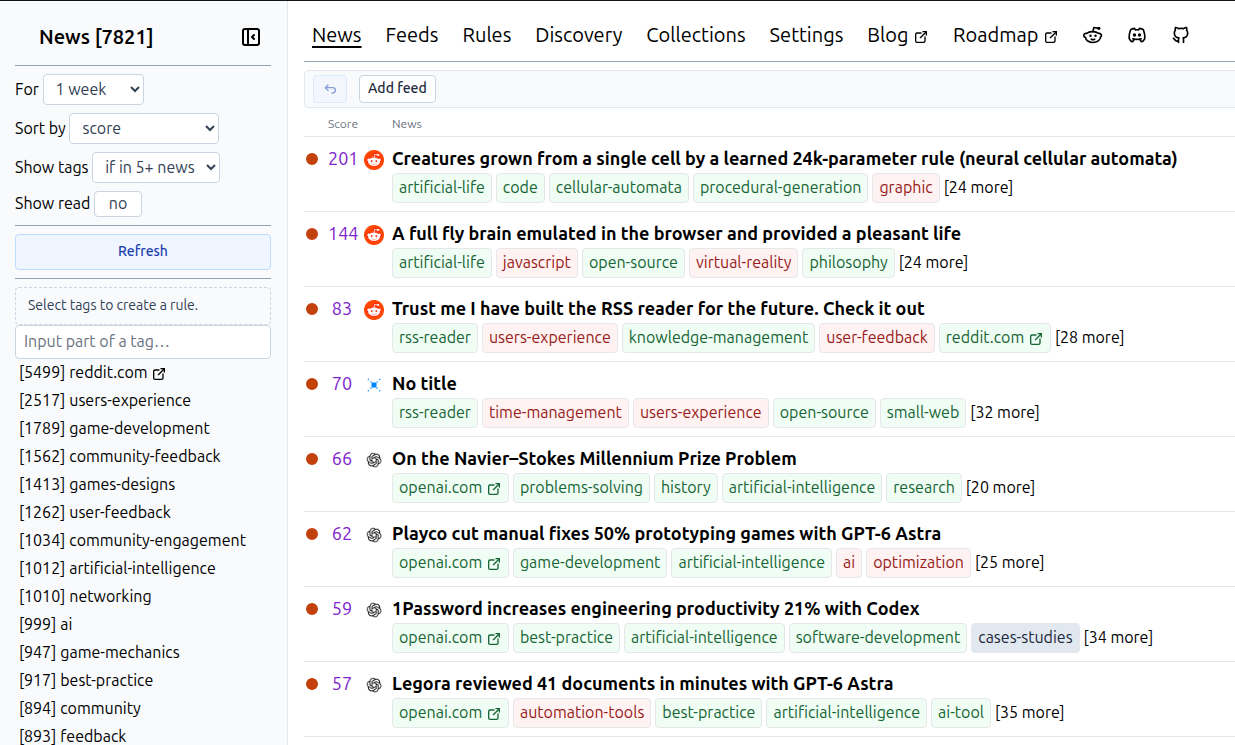
What the interface looks like now.
I finally got closure on my quest for an ideologically correct authentication setup. It took more than two months of continuous facepalms, but it was worth it.
Once again, I refreshed my knowledge of backend metrics collection and built cool dashboards for business and performance metrics.
Got the hang of monitoring LLM output quality and built a quality-control system for the tags Feeds Fun assigns to news. Using the resulting metrics, I implemented tag normalization, which reduced the number of unique tags by roughly a factor of five.
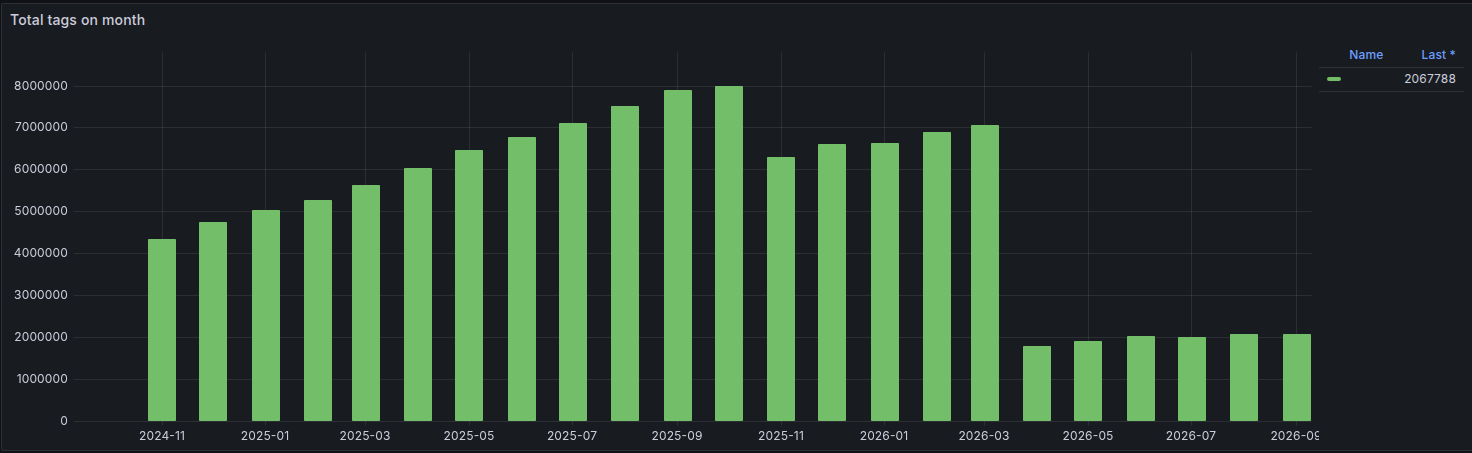
The number of unique tags per month before and after normalization.
While optimizing performance, I ran into a rather illustrative Python problem related to working with external libraries.
Ran a marketing test, which produced rather weak numbers; I assumed it was because users had to enter their OpenAI/Gemini API key, so I decided to push the project to the monetization stage and repeat the test. The required pricing has been calculated; the code for crediting and spending "news tokens" is ready; what remains is to register a legal entity and connect real payments.
Management
While working at Palta, I noticed that during discussions of managerial issues, I don't always speak in a language people understand — as a result, it is difficult to convey my undoubtedly wise managerial ideas to colleagues quickly and easily. Over the years, I've developed my own conceptual framework, which isn't always convenient for other people — and isn't always necessary for them either. Plus, some of my ideas turned out to be too brilliant raw and unpolished. So it was decided: time to sync with reality and get a little more grounded.
To achieve this, I picked a selection of top books on management and read them. It took more time than I planned:
- Most of the books did indeed turn out to be quite good; they fit well with my experience and consequently spawned tons of notes and ideas that I needed to digest.
- It turned out I had way more ideas than I thought, especially about the nature of engineering, its connection with science, and what follows from that. That's why the resulting posts took significantly longer to write. But it was worth it.
As a result, I constructed my own approach to management — a bit radical compared to generally accepted practices — and published a series of essays, which I recommend everyone read, especially the part about the similarity between engineering and science.
Artificial Intelligence
Thanks to the sabbatical, I was able to take my time and figure out, in a calm environment, roughly how it works, what it can and can't do, and what it's likely to be capable of in the near future.
I published numerous posts on this topic — all of them can be found under the tag large-language-models. Here I'll mention only the most interesting ones.
I got a good handle on what LLMs are and forecast how they would develop in the near future. So far, it's holding up — two years and counting:
Gained hands-on experience developing with coding agents.
Released two CLI utilities for coding agents:
- donna — a CLI tool that helps agents keep long-running work on a predefined path.
- depmesh — CLI for discovering dependencies between files in your project, so agents can form context faster and more economically.
More CLI utilities are coming — follow my posts.
I even participated in a podcast:
What AI agents really change in development (Russian language).
World Builders course
The most controversial activity, which probably didn't bring me much direct value, but spawned several activities I consider useful enough to justify the time spent. Also, I definitely had some fun.
The idea, according to the authors (Yaropolk Rash and Alex Polyakov), was to grow the course into something like an MBA for creative directors, but in the end there was only one cohort. A shame — the material was interesting.
The courses inflicted the following benefits on me:
- I synced my world model [ru] with reality in the area of development planning and virtual world design.
- Conducted research into the preferences of strategy game players.
- Played around with some game mechanics on a game prototype.
- Got some practice pitching games [ru] and business planning.
All of this will likely be useful to me over time — unfortunately, just not right now.
Much more importantly, the courses left me itching to build a more substantial game prototype, so I started looking into Rust and Godot.
I didn't like Godot, though I admit it may be the best option for small indie developers.
I changed my opinion about Rust from negative to positive. Now I believe that Rust is the best language for developing with coding agents. If possible, I will do the next commercial project in Rust instead of Python.
"Secret" project
While prototyping games, I started developing an experimental game engine — somehow it just happened :-D. The development started in manual mode before the rise of coding agents, but now it's also an experiment in vibe-coding complex systems. I do this purely in my free time and without a final goal, so there will be no releases in the near future. But if you're interested, here are some of its features:
- Fully deterministic game logic.
- All parameters of the game entities are organized into a single computational graph.
- Strict separation between the game's backend (logic) and frontend (rendering, UI, audio, input, etc.), to the point where multiple frontends can run on different machines against a single backend.
- Built-in logic programming elements.
- Eventually, I want the backend to present itself to external tools as a relational database.
- GUI is implemented as a full-fledged web interface: HTML + CSS + JS/TS/WebAssembly.
- The engine is focused on building games through vibe coding => no visual editors, only code and configs under version control.
So, it's pretty bizarre. Right now, the code looks extremely dirty and ugly, but at least there's one genuinely vibe-coded game.
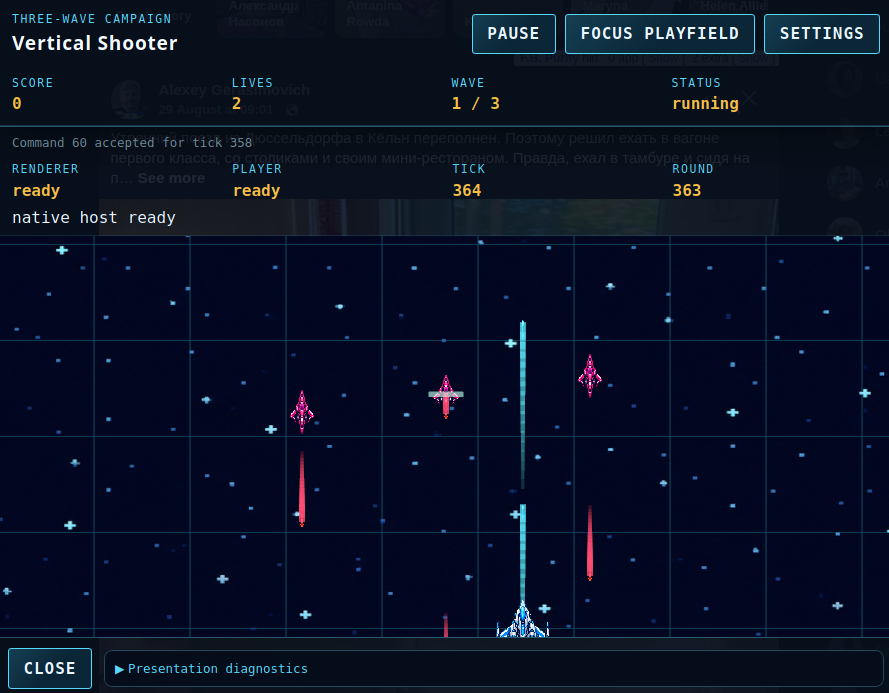
Screenshot of the fully vibe-coded game.
Books
Books went the way they always do: while I was working through the backlog, I bought more, so the backlog didn't get any smaller.
I read 20 books in total:
- Economics: The User's Guide
- The Net And The Butterfly
- Piranesi — highly recommended — Susanna Clarke is brilliant, as always.
- The Signal and the Noise
- 7 books about Harry Potter — I read them as part of exploring English culture, since pretty much every English-speaking young adult grew up on them. I'm extremely unhappy with how little attention the author gives Hermione: the books are about a privileged jock when they should be about a strong, independent redhead from the lower classes.
- 9 books about management.
Other things
A few other activities are worth mentioning.
Besides releasing the lore of The Tale under the CC BY 4.0 license [ru], I also participated in a podcast about the game, where I talked about its history and features.
The game that was ahead of its time.
The blog has undergone major changes:
- Moved from WordPress to a custom engine Brigid.
- All new posts are now published in both Russian and English.
I've been actively working on my English in several areas at once:
- Write posts in English on the blog.
- Read all my books in English.
- Round out my vocabulary with the help of Duocards.
- Farm karma on Reddit.
- Finally found a tutor I study with twice a week.
All the practical matters of settling in Germany are, of course, sorted out — not only by me, but by Yuliya as well.
If you need more details, you can find them in the annual reports:
Takeaways
Besides everything listed above and mentioned in the annual reports, I came away with a few more notes for myself.
First. Building a product "for yourself" and building one "to make money" are two different things. Each direction calls for features and architecture that the other doesn't need. So if you try to move in both directions at once, you'll move more slowly. I'm not sure how I could have avoided this with Feeds Fun, but in the future I'll try to separate these goals at the product level.
Second. Next time, I need to explicitly separate the research track from the product development track. Development should have fixed deadlines and be optimized by cutting scope: anything uncertain gets moved to the research track. Research, on the other hand, should be optimized through prioritization: tackle the most important things first, and whatever doesn't get done simply doesn't get done.
Read next
- My sabbaticals
- Results of the 2019–2021 sabbatical
- Thinking through writing
- Two years of writing RFCs — statistics
- Results of 2025 for me and my blog
- Results of 2024 for me and the blog
- I am a person who…
- Notes on coding agents
- World Builders 2023: Preferences of strategy players
- World Builders 2023: Preparing a business plan for a game on Steam